
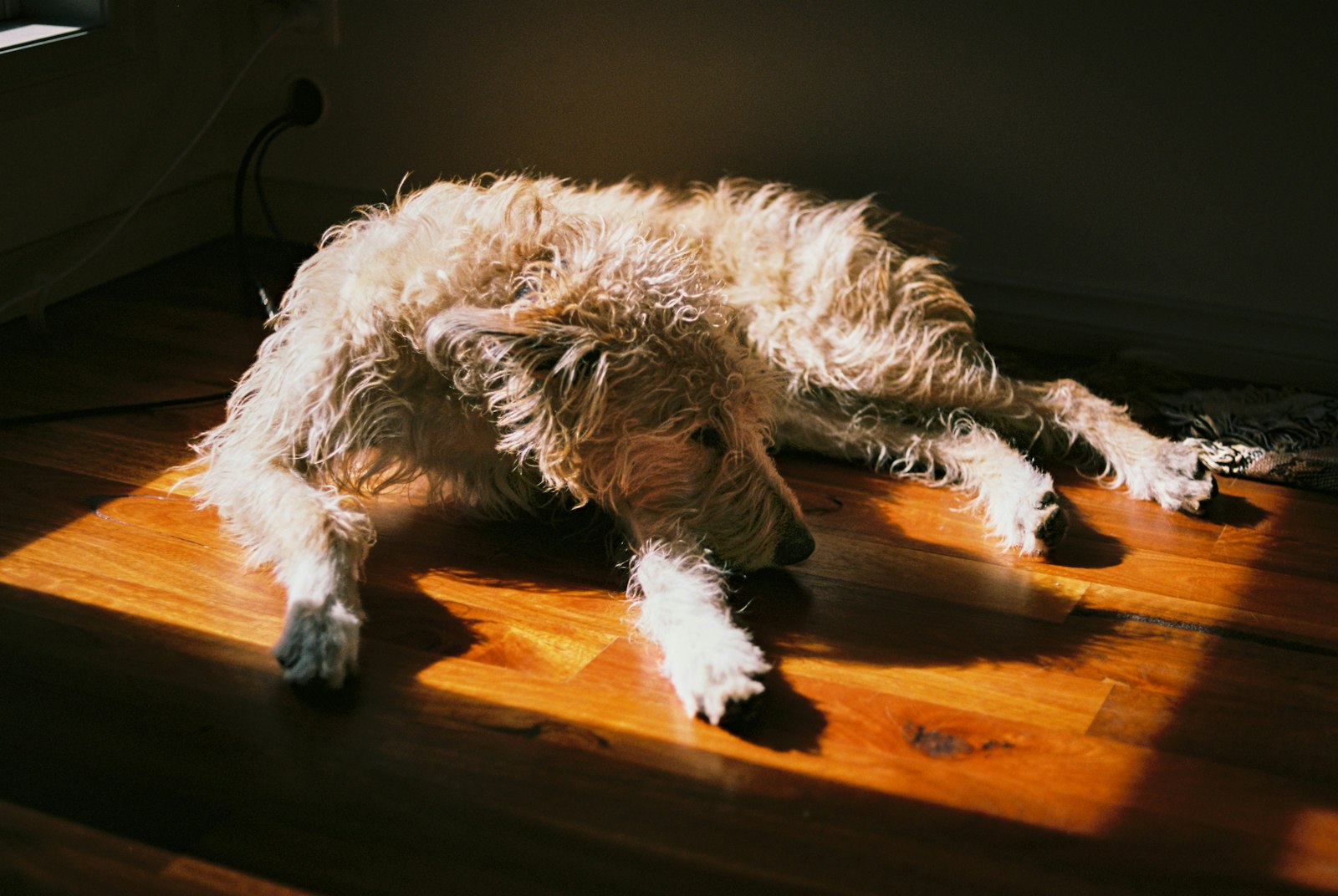
An 80 lb dog that has started skating on the kitchen floor is not being clumsy. Hard floors give nails nothing to bite into, and the bigger the dog, the more weight is riding on a paw that has lost its grip. The most reliable dog paw grips for hardwood floors are Dr. Buzby’s ToeGrips, small rubber rings that fit on the nail tips and stay put for one to three months, and they come in sizes up to XXXL. Four options are compared below, from budget socks to a full lifting harness, along with the two fixes that cost nothing and are worth trying first.
Amazon Associate disclosure: As an Amazon Associate we earn from qualifying purchases. This post contains Amazon affiliate links; if you click and buy, we may earn a small commission at no extra cost to you. See our Disclosures page for details.
Price tiers last checked: August 24, 2026. Tiers compare the picks in this guide, not the whole market. Use any Check Price link for the current price on Amazon.
Dog Paw Grips for Hardwood Floors at a Glance
| Pick | Type | Best for | Price tier |
|---|---|---|---|
| 1. Dr. Buzby’s ToeGrips | Nail grips | Best overall, sizes to XXXL | Mid-range |
| 2. DOK TigerToes Non-Slip Dog Socks | Socks | Best budget, dogs that tolerate socks | Budget |
| 3. Musher’s Secret Paw Wax | Paw pad conditioner | Cheapest option, dry or cracked pads | Budget |
| 4. OneTigris Dog Lift Harness | Support harness | Dogs that need lifting, not just traction | Premium |
Why Big Dogs Slip on Hard Floors
Dogs do not grip with their pads the way we grip with the soles of our feet. They grip with their nails, digging in slightly the way a sprinter uses spikes. Hardwood, tile, laminate and vinyl give a nail nothing to dig into, so the paw slides and the dog compensates by splaying its legs, which is the posture most owners recognise before they recognise the problem.
Weight makes it worse in two directions. A large dog carries more load per paw, and it also has more leverage working against a joint when a leg slides sideways. That is why a Labrador loses confidence on a slick hallway years before a spaniel does, and why the same floor a puppy skids across for fun becomes genuinely dangerous at ten.
Confidence is the part that catches people out. A dog that has slipped badly once will often stop crossing that floor entirely, and start taking a longer route through the house or refusing to come to the kitchen at all. Owners read that as stubbornness. It is usually fear of a surface, and it responds quickly once the traction problem is fixed.
One caveat worth stating plainly: a sudden change in how a dog moves is worth a vet conversation, not just a gear purchase. Slipping that comes on quickly, drags a back foot, or affects one side more than the other can point to arthritis, hip problems or a nerve issue. Traction gear makes a slippery floor safer. It does not treat the reason a dog is weak. If your vet confirms hind-end weakness, a lift harness for large dogs can help on the days the floor still wins.
Types of Dog Paw Grips for Hardwood Floors
Nail grips
Small rubber bands that fit over the tip of each nail and restore the nail’s ability to bite into a smooth surface. Best for: dogs with normal nails that need traction all day without anything on their feet. They stay on for weeks at a time, so there is no daily routine to keep up.
Non-slip socks
Fabric socks with a rubberised grip on the sole. Best for: short-term use, dogs that will tolerate something on their paws, and households wanting the cheapest way to test whether traction is the actual problem. The two weaknesses are the same everywhere in this category: they twist, and dogs remove them.
Adhesive paw pads
Disposable rubber or foam pads that stick to the paw pad for a few days. Best for: a short recovery period after surgery. They are the weakest option in the category. Sweat, hair and movement all work against the adhesive.
Paw pad coatings
A non-toxic adhesive plus a granular grit, applied to the pads themselves to create a textured surface. Best for: dogs whose nails are too short, brittle or oddly shaped to hold nail grips. It needs reapplying, but it works on a paw where nothing can be attached to the nail.
Support harnesses
Not traction at all, strictly speaking. A full-body harness with handles lets you take weight off a dog’s back end on stairs or during a rise. Best for: large dogs whose problem has moved past grip and into strength. Often used alongside grips rather than instead of them.
Best Dog Paw Grips for Hardwood Floors: Our Top Picks
1. Dr. Buzby’s ToeGrips: Best Overall

ToeGrips are rubber rings that grip the nail itself, which is the part of the paw a dog was using for traction in the first place. They do not need glue, they go on dry, and the brand states they stay in place for one to three months before they need replacing. That is the practical argument for them over socks: there is no nightly routine and nothing to lose under the sofa.
Sizing runs XS to XXXL and is based on nail size rather than body weight, with a breed and weight lookup on the product page to point you at the right one. Large dogs generally land in the L to XXXL range. The brand offers an autoship discount, and its store shows 1,845 reviews against the product with a 30 day money-back guarantee.
The honest weakness is application. Fitting twenty small rubber rings onto the nails of a dog who would rather not is fiddly the first time, and the brand sells a super glue gel as an alternative method, which tells you something about how often the standard method needs help. Nails also need enough length to hold a grip, so a dog trimmed very short will need to grow them out first.
Mid-range price tier, check current price.
Pros:
- Works with the nail rather than covering the paw
- Stays on for one to three months, no daily routine
- Sizes up to XXXL for very large breeds
- Vet-developed, made in the USA, 30 day guarantee
Cons:
- First application is fiddly and takes patience
- Needs nails long enough to hold a grip
- They are a consumable, so the cost recurs
2. DOK TigerToes Non-Slip Dog Socks: Best Budget Option

If you want to know within an hour whether traction is really the problem, socks are the cheapest test. TigerToes are the best-known product in this category, sold as a pack of two pairs, and they are sized by paw width rather than dog weight: Large fits a paw 2.5 to 2.8 inches across, measured while the dog is standing on it, with an X-Large above that.
The grip material is deliberately thick, which is why the brand warns that they feel stiffer than ordinary dog socks. That stiffness is the point, since a thin sock twists and puts the grip on top of the paw. Even so, they are typical of the category: they work, and a determined dog will still get them off.
Budget price tier, check current price.
Pros:
- Cheapest way to test whether traction fixes the problem
- Sized by actual paw measurement, not guesswork
- Long-established product in a crowded category
- Washable and reusable
Cons:
- Come off, especially on dogs that resent them
- Not suitable for unsupervised all-day wear
- A determined dog can still pull them off
3. Musher’s Secret Paw Wax: Best Pad Treatment When Nails Won’t Hold a Grip
Musher’s Secret takes a different angle than a grit coating: it is a food-grade wax balm worked into the pad itself, developed for sled dogs to guard against ice, salt and hot pavement. It is not purpose-built as a traction product, but the wax conditions dry or cracked pads, and some owners report it also cut down on hardwood slipping as a side effect of healthier pads. A 2.1 oz tin is also the cheapest pick on this page.
This is a reasonable fallback for the dogs the nail-based options fail: nails clipped too short, brittle nails, missing nails, or a paw shape that will not hold a ring. The honest trade-off is that it is a conditioning wax rather than a dedicated grip system like PawFriction’s granular coating, so do not expect it to fully replicate that mechanism. It also has to be reapplied as it wears, and a heavy layer left for a dog to lick can upset a sensitive stomach, so wipe off any excess.
Budget price tier, check current price.
Pros:
- Cheapest option on this page by a wide margin
- Doubles as protection against hot pavement, ice and salt
- Sold on Amazon rather than a single small brand’s own store, so restocks are easy to track
Cons:
- A conditioning wax, not a dedicated traction coating like PawFriction
- Needs reapplying as it wears
- High-fat content can upset a dog’s stomach if licked off in quantity
4. OneTigris Dog Lift Harness: Best for Dogs That Need Lifting
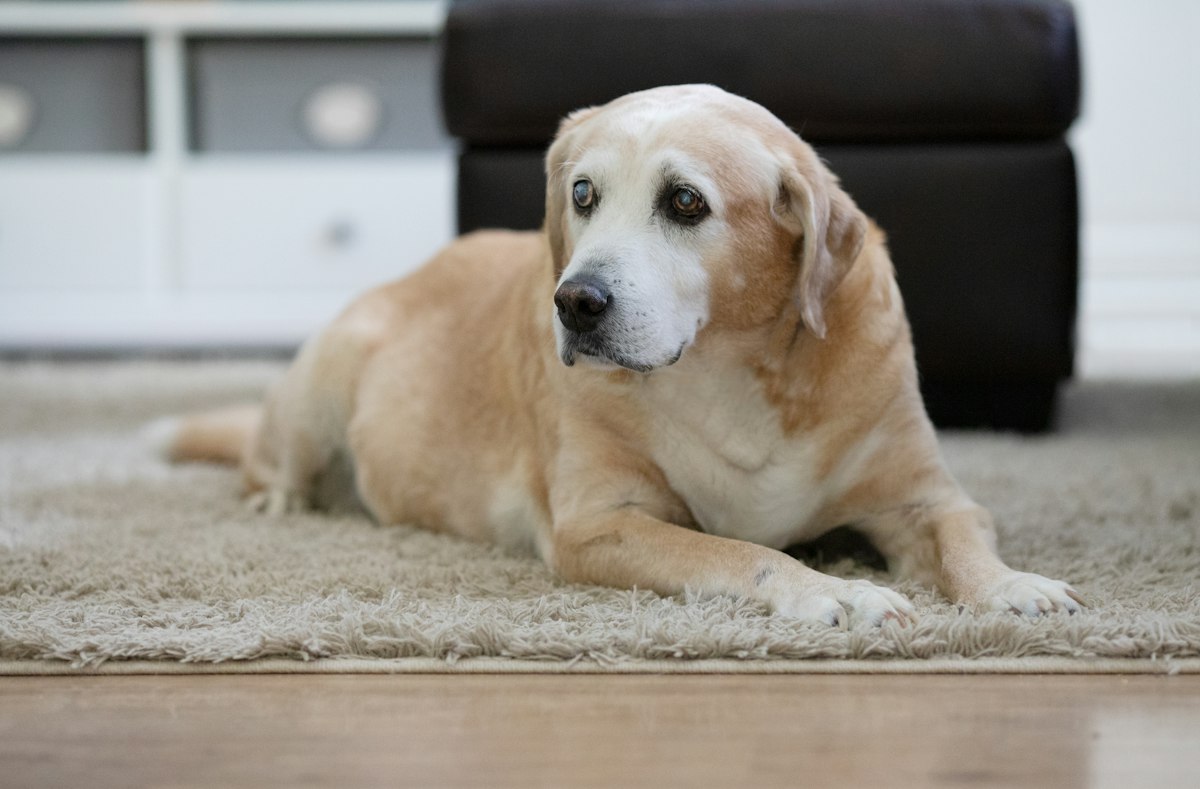
At some point traction stops being the issue and strength is. The OneTigris Dog Lift Harness is a full-body harness with three grab handles (front, center and rear) plus detachable, padded rear-leg straps, so you can steady a back end on a staircase or help a dog rise without hauling on a collar or improvising with a towel. Sizing goes by weight from Small (18 to 32 lbs) through XXL (140 to 180 lbs), all at a single price regardless of size.
It is not the exact harness this section originally pointed to, but it does the same job at a fraction of the price with far more reviews to check against on Amazon. For a large dog with genuine hind end weakness, it is also the only item here that changes what the two of you can still do together, and it pairs well with grips rather than replacing them. If the difficulty is mainly getting into a car or onto a bed, a ramp solves that problem more cheaply.
Premium price tier, check current price. The same across every size, S (18 to 32 lbs) through XXL (140 to 180 lbs).
Pros:
- Lets you take real weight off a large dog
- Three grab handles plus detachable, padded rear-leg straps
- Sized from 18 lbs to 180 lbs
- Works alongside nail grips rather than instead of them
- Single price regardless of size, and far more Amazon reviews to check against than a small brand’s own store
Cons:
- Costs several times as much as grips
- More harness than most slipping dogs need
- A few reviewers note the rear-leg straps take patience to position on a dog that will not stand still
How to Choose Dog Paw Grips for Hardwood Floors
Start with the paw, not the price. Nail grips need nails with enough length and substance to hold a ring, socks need a paw you can measure across while the dog is standing on it, and a pad coating needs pads in reasonable condition. Most owners can rule out one of the three formats in about a minute by looking at the dog’s feet.
Then be realistic about the dog. Anything you put on a paw gets tested, and some dogs will strip socks off before you reach the hallway. If that is your dog, skip the sock stage entirely and go to nail grips, which the dog largely forgets about because nothing is covering the paw.
Match the format to how long you need it. Post-surgery traction for a fortnight is a different purchase from managing an arthritic ten year old for the next three years. Cheap disposable pads are defensible for the first and poor value for the second, where nail grips lasting one to three months per set are the better arithmetic.
Size properly. Every product in this category is sized, and most of the poor reviews across all of them read like sizing failures rather than product failures. Weight-based sizing is a rough guide for harnesses. For grips and socks, measure. The same principle applies to any large-dog gear, and our harness sizing guide covers how to measure a big dog properly.
The Free Fixes to Try First
Trim the nails. This is the single most overlooked cause of slipping, and it works in the opposite direction to what people expect. Overgrown nails hit the floor before the pad does, which tips the toe up, pushes the paw out of position and reduces the contact the dog has with the ground. If you can hear the nails clicking across a room, they are long. Our guide to nail grinders for large dogs covers doing this at home without a fight.
Trim the hair between the pads. On thick-coated breeds that tuft grows over the pad and turns the paw into a skid. A groomer will do it in two minutes, and it can resolve a mild slipping problem entirely on a Golden or a Shepherd without you buying anything.
Add runners on the routes that matter. You do not need to carpet the house. A dog uses the same three or four paths through it, and a couple of non-slip runners on the hall, the turn into the kitchen and the landing at the top of the stairs cover most of the risk. Rubber-backed rugs stay put; woven ones on a slick floor make the problem worse.
Look at the stairs first. Stairs are where a slip does real damage, and they are also the cheapest place to fix, since a stair runner or a set of adhesive treads solves the whole flight. If a large dog has already started refusing the stairs, treat that as information rather than a training problem.
One thing that does not help: dog boots. They are excellent outdoors, on hot pavement and on ice, and our boots guide covers those properly. Indoors they are hot, most dogs walk strangely in them, and the sole is usually smoother than a purpose-made grip.
Frequently Asked Questions
Do dog paw grips for hardwood floors actually work?
For most dogs, yes, provided the cause really is traction. Nail grips restore the bite a nail has lost on a smooth surface, and owners often see a difference on the first walk across the room. What they will not fix is weakness, pain or a neurological problem, where the dog is falling for a reason other than the floor.
How long do nail grips stay on a dog?
Dr. Buzby’s state one to three months per set, and they are designed to stay on continuously rather than come off at night. Nails grow, so a grip near the tip works its way off eventually. Expect to check them over every few weeks and replace the ones that have gone missing.
Are non-slip socks or nail grips better for a large dog?
Socks are cheaper and instant, so they are the better first test. Nail grips are the better long-term answer for a big dog, because there is nothing to twist, nothing to come off overnight, and nothing covering a paw the dog would rather have uncovered. Plenty of households end up owning both.
Will trimming my dog’s nails stop the slipping on its own?
Sometimes, and it is worth doing before you buy anything. Overgrown nails strike the floor before the pad and rotate the toe out of position, which reduces grip and loads the joint oddly. If you can hear clicking as the dog crosses a room, trim first and reassess.
My dog has suddenly started slipping. Is that normal ageing?
Gradual change over months is common in older dogs. A sudden change, a dragging back foot, or slipping that affects one side more than the other is worth raising with a vet, because those patterns can point to joint or nerve problems rather than a slippery floor. Traction gear is useful either way, but it is not a diagnosis.
Which One Should You Buy?
The order to work through is trim, then test, then commit. Nails and paw hair first, because they are free. Socks next, because a cheap pair tells you whether traction is the whole story. Only then spend on something permanent.
- Dr. Buzby’s ToeGrips for most large dogs. Sizes to XXXL, one to three months per set, and nothing on the paw for the dog to object to.
- DOK TigerToes socks as the cheap first test, sized by paw width.
- Musher’s Secret Paw Wax, the cheapest option, when pads are dry or cracked rather than purely slick.
- OneTigris Dog Lift Harness when the problem has moved from grip to strength.
- Trim the nails and the hair between the pads before buying any of it. It is free and it sometimes ends the problem.
A dog that has stopped crossing the kitchen is telling you something specific. Give it a surface it can trust and most of that confidence comes back quickly, often within a day or two.
Get the free Big-Dog Gear Starter Checklist
The exact gear a large dog actually needs, with our #1 pick in every category, from bowls to GPS trackers. Enter your email and we’ll send the printable checklist straight to your inbox (plus the occasional big-dog gear guide, no spam).