
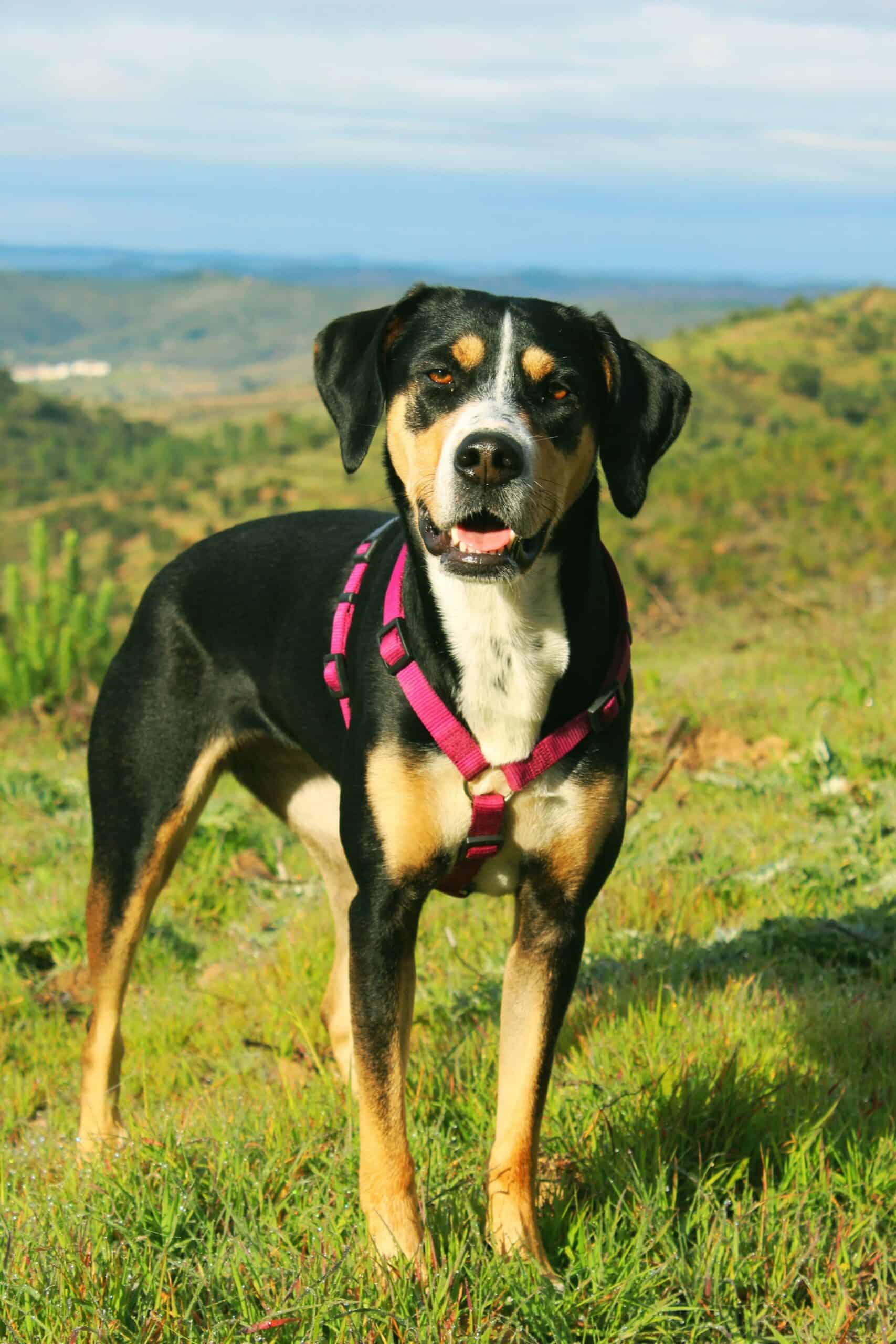
The right size for a large dog’s harness comes down to chest girth, not weight. Measure around the widest part of your dog’s rib cage just behind the front legs, then check that measurement against the manufacturer’s chest-girth range: not just the weight range, since two large dogs of the same weight can have very different builds. Here’s exactly how to measure, read a size chart, and spot a bad fit before it causes chafing or an escape.
For a broader view of how large and giant breeds compare on weight, see our large dog breed weight chart.
Guide last updated: July 26, 2026.
Why Fit Matters More for Large Dogs
A harness that’s slightly loose on a 20-pound dog is a minor annoyance. On an 80-pound dog pulling toward a squirrel, that same looseness turns into real force concentrated on a few straps: enough to cause chafing, pressure sores, or in the worst case, let the dog back out of the harness entirely. Broad-chested large breeds also need coverage that a size chart based on weight alone won’t always capture.
How to Measure Your Dog for a Harness (Step-by-Step)
- Have your dog stand naturally: a sitting or slouching dog will give you an inaccurate, smaller measurement.
- Wrap a soft measuring tape around the widest part of the rib cage, just behind the front legs. This is the chest girth, and it’s the single most important number for harness fit.
- Keep the tape snug but not tight: you should be able to slide two fingers under it comfortably.
- If the harness also has a neck strap, measure around the base of the neck where a collar would sit, not further down near the shoulders.
- Write down both numbers in inches, then weigh your dog as a secondary check: weight alone is a rougher estimate and can be misleading for barrel-chested or narrow-chested large breeds.
Reading a Harness Size Chart Correctly
Every brand sizes differently, so match your chest-girth measurement to that specific manufacturer’s chart rather than assuming “large” means the same thing across brands. A few things to keep in mind:
- Chest girth is the primary number: use it first, and treat weight as a sanity check rather than the deciding factor
- The same girth can map to different sizes depending on weight: a 30-inch chest girth might be a medium on a 50-lb dog, a large on a 75-lb dog, and an extra-large on a 100-lb dog, because heavier dogs need sturdier hardware and webbing even at a similar girth
- If your dog measures right between two sizes, size up rather than down: a slightly loose harness can usually be tightened at the straps, but one that’s truly too small won’t open up enough to fit properly
- For a growing large-breed puppy, re-measure every few weeks rather than assuming the harness will still fit next season
Signs Your Harness Doesn’t Fit Right
Too loose
- You can pull the harness more than an inch or two away from the body at the chest or shoulders
- Your dog has backed out of it once already, even accidentally
- The harness rotates or slides to one side during walks
Too tight
- Fur is rubbed thin or the skin looks red anywhere the straps sit
- You can’t fit two fingers under any strap
- Your dog resists putting it on or seems to move stiffly once it’s buckled
Common Sizing Mistakes with Large Dogs
- Sizing by weight alone. Two 70-pound dogs can have very different chest girths depending on build, so weight-based charts are only a starting point.
- Measuring over a thick winter coat. This inflates the girth measurement and can leave the harness too loose once the coat sheds out.
- Assuming the same size across brands. A large in one brand’s chart can be equivalent to a medium or extra-large in another’s.
- Not rechecking fit after weight change. Weight loss, muscle gain, or seasonal coat changes can shift fit enough to need a different size.
Breed-Specific Fit Notes
Broad-chested breeds (Labradors, Golden Retrievers, Boxers) generally need more width across the chest plate and benefit from a harness with multiple adjustment points rather than a fixed-width front strap.
Deep-chested, narrow breeds (Greyhounds, German Shepherds) often need a harness with more adjustability at the girth strap, since a chart built around a stockier build may run tight through the ribcage even at the “correct” size.
Short-legged, heavy-bodied large breeds (Bulldogs, Basset Hounds) may need a shorter body length setting even at a large girth size, so check the harness’s length adjustment range, not just girth, before buying.
If you haven’t picked a harness yet, our guide to the best dog harnesses for large dogs compares three no-pull picks with their actual chest-girth ranges.
If crash safety in the car is a priority, our guide to crash-tested dog harnesses compares options with independently published safety-testing data once you’ve got the right size.
Sizing a harness and a collar use different measurements. See our guide to the best dog collars for large dogs if you need both.
FAQs About Sizing a Harness for Large Dogs
Should I size a harness by weight or by measurement?
Always measure chest girth with a tape measure first. Use the manufacturer’s weight range only as a rough cross-check, since build varies enough between individual large dogs that weight alone can put you in the wrong size.
What if my dog measures between two sizes?
Size up. Most harnesses have enough strap adjustment to tighten a slightly large fit, but a harness that’s truly too small won’t open up enough to fit comfortably, and may rub or restrict movement.
How often should I re-measure my dog?
Re-measure every few weeks for a growing puppy, and at least once a year for an adult dog, especially after any noticeable weight change or after a seasonal coat blows out.
Can a harness be too big to be dangerous?
Yes. A harness that’s too loose can let a dog back out of it entirely, especially one that’s startled or pulling hard, which is a real safety risk near roads or off-leash areas.
Do I need a different harness size for winter?
Usually not a different size, but you may need to loosen the straps to accommodate a thicker winter coat, then tighten them back down once the coat sheds in warmer months.
Is the two-finger rule accurate for all large dogs?
It’s a solid general guideline, but very large or heavily muscled dogs may need slightly more than two fingers of room to account for muscle flexing during movement, while lean, deep-chested breeds may need a snugger fit to prevent slipping.
Get the free Big-Dog Gear Starter Checklist
The exact gear a large dog actually needs, with our #1 pick in every category, from bowls to GPS trackers. Enter your email and we’ll send the printable checklist straight to your inbox (plus the occasional big-dog gear guide, no spam).